Key takeaways
- Flash is banned. Use a wide aperture and raise your ISO instead of slowing the shutter too far.
- A zoom in the 24–105 mm or 70–200 mm range covers most gorilla encounters at 7 metres.
- Expose for the gorilla’s face; dark fur against bright leaves fools camera meters.
- Habituation gives you up to four hours, which is the biggest advantage a photographer can have.
Why gorilla photography is hard
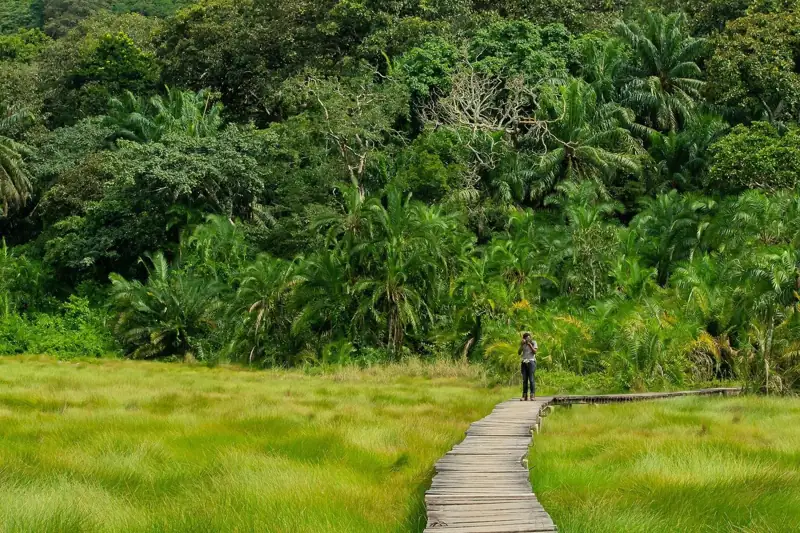
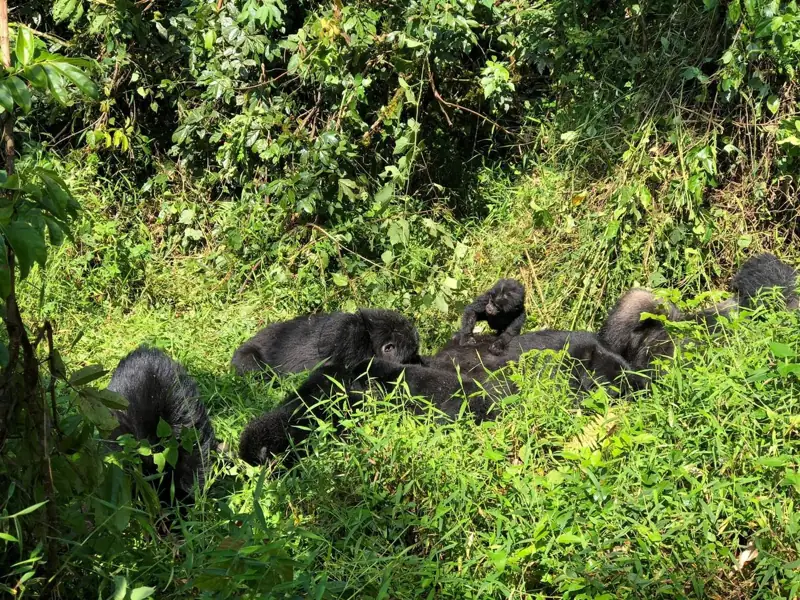
Bwindi is a dense rainforest. Under the canopy the light is low and patchy, with bright gaps and deep shadow side by side. Gorillas are large, dark animals that often sit in thick vegetation, so cameras struggle to focus and expose correctly.
On top of that you are limited by the rules: no flash, a minimum distance of 7 metres and one hour on a standard trek. Good preparation makes the difference between a memory card of blurry dark shapes and portraits you will print.
Camera settings for low forest light
- Shooting mode: aperture priority or manual with auto ISO, so you control depth of field while the camera adjusts.
- Aperture: as wide as your lens allows, f/2.8 to f/5.6, to let in light and blur busy backgrounds.
- Shutter speed: at least 1/250 s for a moving gorilla, and around 1/125 s for a resting one if you are steady.
- ISO: do not be afraid of ISO 1600 to 6400 on a modern camera. Noise is easier to fix than blur.
- Focus: single-point autofocus on the eye, and continuous focus if the gorilla is moving.
- Exposure compensation: often minus two-thirds to minus one stop, to keep black fur from turning grey and bright leaves from blowing out.
Lenses and gear
A fast mid-range zoom is the most useful lens. Something like a 24–105 mm or 70–200 mm lets you frame a whole family or a close portrait without changing lenses in the rain. A longer lens helps when gorillas are higher in the trees, but very long, heavy lenses are hard to handle on steep slopes.
- Bring two batteries and two memory cards, and keep spares in a dry bag.
- Leave the tripod and monopod at the lodge; there is rarely room to set one up.
- A rain cover or a simple plastic bag protects your camera in sudden showers.
- Phones can take good photos in this light now. Use night or portrait modes and hold still.
Composition and technique
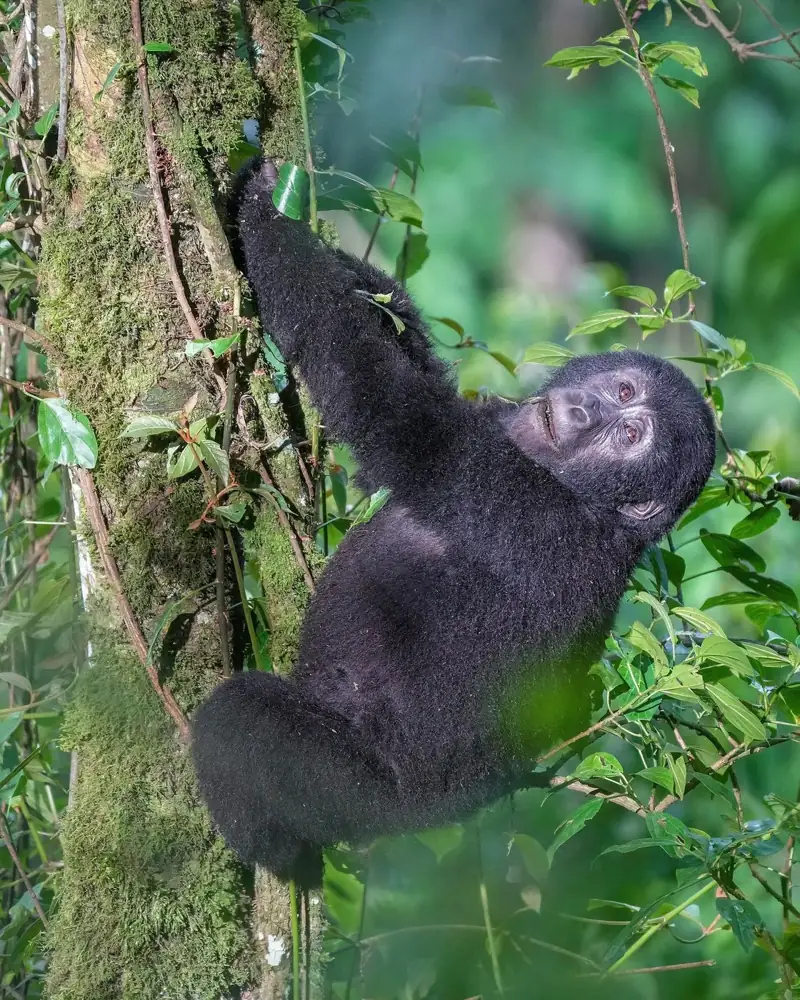
Wait for the eyes. A gorilla photo comes alive when the eyes are sharp and catch a little light. Be patient through moments when the face is hidden in leaves.
Change your angle within the rules: a slightly lower position often gives a more intimate portrait. Look for behaviour as well as portraits: a juvenile chewing a stem, a mother grooming an infant, the silverback’s hands. These tell the story of your encounter.
Keep some time for wider frames that show the forest, and for simply watching. Many guests say they wish they had lowered the camera a little sooner.
Why habituation is better for photographers
On a standard trek you have one hour, often in thick vegetation. On the Gorilla Habituation Experience you have up to four hours, which means more chances for the light to change, the gorillas to move into the open and behaviour to unfold.
Families still being habituated also behave less predictably, so you may capture moments rarely seen on standard treks. Our Habituation & Photography Safari combines habituation with a second gorilla family and golden monkeys.
Photography rules in Bwindi
- No flash, focus-assist lights or camera sounds near the gorillas.
- Stay at least 7 metres away, even for a better angle.
- No drones.
- Follow your ranger’s instructions about where to stand.
Gorilla Photography FAQs
Can you use flash when photographing gorillas?
No. Flash photography is not allowed near the gorillas in Uganda.
What is the best lens for gorilla photography?
A fast mid-range zoom such as a 24–105 mm or 70–200 mm covers most situations at the required 7-metre distance.
Is a phone good enough for gorilla photos?
Modern phones do well in low light if you hold still and use night or portrait modes, though a camera with a zoom gives more flexibility.
Can I bring a drone?
No. Drones are not allowed in Uganda’s national parks without special permission.

Gorilla Safari Experience team
Our Uganda-based team plans gorilla habituation safaris in Rushaga and updates these guides each season. About us