
The short answer: choose standard gorilla trekking if it is your first gorilla encounter, your time is short or you want the widest choice of dates and sectors. Choose the Gorilla Habituation Experience if you want up to four hours with a family, a group of no more than four, and a close look at how researchers work. If you can, do both on separate days.
Habituation vs. trekking at a glance
| Gorilla Habituation Experience | Standard gorilla trekking | |
|---|---|---|
| Time with gorillas | Up to 4 hours | 1 hour |
| Group size | Maximum 4 visitors | Maximum 8 visitors |
| Permit (foreign non-resident) | US$1,500 | US$800 |
| Where in Uganda | Rushaga sector, Bwindi | All four Bwindi sectors and Mgahinga |
| Gorilla family | Still being habituated | Fully habituated |
| You walk with | Trackers and researchers | Ranger guide and trackers |
| Daily places in Uganda | 8 | Over 150 |
| Typical day in the forest | 6 to 8 hours | 3 to 6 hours |
| Minimum age | 15 | 15 |
Permit prices are set by the Uganda Wildlife Authority and reviewed periodically. We confirm the current rate when we book. All gorilla permits are non-refundable.
1. Time with the gorillas
This is the headline difference. On a standard trek the one-hour clock starts when your group reaches the family, and rangers are strict about it. An hour sounds short, but most people find it intense and satisfying: you watch feeding, grooming and youngsters playing, then walk out.
On the habituation experience you can stay for up to four hours. That changes the encounter. In the first hour most people are busy taking photos. In the second and third hours you start noticing individuals, how the silverback decides when the group moves, how juveniles test the adults, and how the family reacts to the researchers around you. If you want to watch behaviour rather than just see gorillas, the extra time is what you are paying for.
2. Permit cost
For foreign non-residents a habituation permit costs US$1,500, nearly double the US$800 standard trekking permit. Foreign residents and East African citizens pay lower rates for both. The permit covers park entry for the day, the ranger guide and your time with the family. It does not include transport, lodges, porters or tips.
Viewed per hour, habituation is actually better value: around US$375 per hour with the gorillas against US$800 for a standard trek. The real question is whether you want the extra hours. Our gorilla trip cost guide shows how the permit fits into a full budget.
3. What you see and how the family behaves
Trekking families are fully habituated. They have spent years being visited every day and largely ignore people, which gives relaxed, predictable encounters and good photography at close range.
Habituation families are still in the process. They are more alert, younger animals may hang back or chest-beat, and the silverback may make a bluff display to check whether you are a threat. Researchers make soft contact vocalisations, log feeding and note how each gorilla reacts. You see the work that turns a wild family into one tourists can visit, which many guests say is the most memorable part of the day.
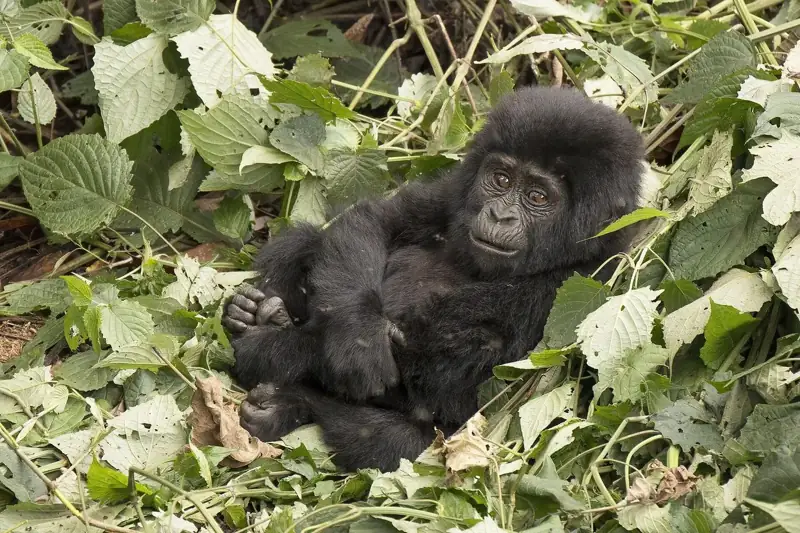
4. Difficulty
Both are hard walks. Bwindi is steep, muddy and high, with ridges above 2,000 metres. The difference is how much of the walk is off-trail and how long you are out. Trackers follow a habituation family wherever it goes, often cutting a path through undergrowth, and with four hours at the family plus the walk in and out, a habituation day commonly runs to six or eight hours.
A standard trek can be anything from a one-hour walk to most of the day, depending on where your family is. Rangers try to match fitter groups with families further away, which helps if mobility is a concern. Either way, a porter and a walking stick make a real difference. Our fitness preparation guide has a six-week plan.
5. Availability and booking
Habituation runs only in the Rushaga sector, with two families taking four visitors each. That makes eight places a day across Uganda, and they are the first permits to sell out for June to September and December to February. Book six to twelve months ahead for those months.
Standard trekking permits are spread across Bwindi’s four sectors and Mgahinga, with well over a hundred places a day. You still need to book early for peak months, but you have far more flexibility on dates and sectors. In both cases the Uganda Wildlife Authority requires full payment to issue a permit, and permits are non-refundable.
6. Who each option suits
Choose habituation if you
- Want more than an hour and a smaller group
- Are a photographer who needs time to wait for light and behaviour
- Have trekked before and want a different experience
- Are fit enough for a long day off-trail
- Are interested in research and conservation
Choose standard trekking if you
- Are seeing gorillas for the first time
- Have limited time or want to keep costs down
- Need specific dates or a particular sector
- Prefer a shorter day in the forest
- Are travelling with teenagers who are new to hiking
Can you do both?
Yes, and it is one of the best ways to see gorillas. Rushaga has both habituation families and several fully habituated families, so you can do a habituation day and a standard trek from the same lodge, ideally with a rest day between. Comparing the two families is fascinating: one relaxed and used to people, one still deciding what to make of you.
Our Double Family Experience is built around exactly that, and the Habituation & Photography Safari pairs habituation with a second gorilla family and golden monkeys.
Habituation vs. trekking FAQs
Is gorilla habituation worth the extra cost?
For most repeat visitors, photographers and anyone keen on gorilla behaviour, yes. You get up to four hours instead of one in a group half the size. First-time visitors with limited time often find a standard trek is enough.
Is habituation harder than gorilla trekking?
Usually, because more of the walk is off-trail and the day is longer. The terrain is the same, so anyone fit enough for a long hilly hike can do either with a porter.
Can you do gorilla habituation in Rwanda?
No. The Gorilla Habituation Experience is offered only in Uganda, in the Rushaga sector of Bwindi Impenetrable National Park.
Do you get closer to the gorillas on habituation?
No. The same distance rule of at least 7 metres applies, and families still being habituated may keep more distance themselves. The difference is time and the research context, not proximity.
Which is better for photography?
Habituation gives you far more time to wait for good light and behaviour. Standard trekking families are more relaxed, so you may get closer, calmer portraits in your hour. Serious photographers often do both.

Gorilla Safari Experience team
Our Uganda-based team plans gorilla habituation and trekking safaris in Bwindi. About us